

After the heavy lunch at Habibi Restaurant, the next destination was the Karkhano Bazaar. Before we started our shopping spree, we decided to stop at one of the famous local mosques, Mahabat Khan Masjid, to perform our namaz (prayer). It is a 17th-century Mughal-era mosque. The mosque was built in 1630, and named after the Mughal governor of Peshawar, Nawab Mahabat Khan bin Ali Mardan Khan. The mosque’s white marble facade is considered to be one of Peshawar’s most iconic sights.


The structure of this mosque is somehow similar to the Badshahi mosque in Lahore. Badshahi mosque was also built during the same Mughal-era. The distinctive feature that I liked of both these mosques is that the actual main prayer area is rather small, while the vast remaining area is an open courtyard surrounded just by walls without roof. The courtyard has lesser facilities, as this area will only be utilized during jummah (Friday) and Eid prayers. Similar arrangement can be seen in almost all the mosques in Pakistan. This arrangement reduces the cost for maintaining the mosques. Only a smaller area of the actual mosque, which is routinely utilized for 5 times prayers, are properly equipped and furnished.
The Mahabat Khan mosque is nestled within a crowded bazaar area. We could not help ourselves from stopping to at least do window shopping. One of the unique shops that caught our attention was copper craft shop. There was one copper ‘khat’ (Islamic calligraphy) art piece which caught the attention of my friend. He wanted to buy it. As usual, he tasked me to negotiate. Hoping my local look and my broken urdu will help. Unfortunately, the shop owner didn’t understand my Malaysian Urdu and I don’t understand Pashto at all.
“Aku tak faham langsung la apa dia cakap”, I explained to my friend, who was standing beside me.
“Apa khabar bhai” I heard a voice from behind interjected my conversation.
When I turned, there was this neatly dressed Pathan who had a broad smile and most welcoming look. With my chest pushed upward, “Theek tak”, I replied confidently. If the Pathan can speak Malay, I can also speak his language.
Just then I realized I was in Peshawar and they speak Pashto not Urdu and ‘theek tak’ means ‘fine’ in Urdu. I actually don’t know how to reply to him in Pashto. I added immediately, “Alhamdulillah khabar baik”.
The Pathan was quick to continue the conversation. “Abang dari mana?”. I was impressed to see him talking in Malay and this was happening in Peshawar, which is more than four thousand kilometers away from Malaysia.
“Kami dari Malaysia” I answered dumbly to him. He smiled and told me he worked in Johor. When he asked me where we were from, I should have answered from which state. He definitely would have already figured out that we were from Malaysia.
He knew that we were trying to bargain with the shop owner. Without any hesitation, he asked the shop owner for a discount. “Abang, dia cakap boleh kurang dua ribu”. He explained. “Kami nak beli kalau dia setuju harga sepuluh ribu”, I explained our side of the bargain. We saw him arguing fiercely with the shop owner. I was amazed by his attitude. We were strangers—even our introduction was brief, yet he represents us like our defense lawyer in a legal proceedings. He turned towards us with a big smile. “He got the price we asked for”, I mumbled. He told us the shop owner agreed for another one-thousand discount only. Why the broad smile then, I grumbled in my heart. “Abang, ambil, saya akan bayarkan”. He told us calmly.
One thousand rupees is equal to around RM35. Minimum salary in Pakistan is around thirteen thousand. For him to pay anything more than one thousand for someone whom you just met is crazy. But this is Peshawar. This city is known for it’s hospitality. Their kindness is totally out of this world.
Tourists, particularly from Western countries, shied away from Peshawar particularly and Pakistan generally due to constant negative propaganda portrayed in the Western media.
What was propagated was far from the truth. Recently, Peshawar was visited by many western bloggers, Drew Binsky, Peter Santenello and Jay Palfrey to name a few. Also solo female bloggers such as Rosie Gabrielle. They have debunked these propaganda with their own personal experiences. At least two of these Western bloggers have gone to an extent to name Peshawar as the most friendliest and kindest city in the world.
Watch some of those bloggers videologs here.
We politely rejected the offer by the Pathan. My friend paid the final bargained price and we proceeded to our prime destination in Peshawar, Karkhano bazaar.
The bazaar was formally known for smuggled goods. Due to its proximity to Afghanistan, many goods brought in by US soldiers were smuggled here and sold in black.
However, these days the bazaar has been reformed and now it sells items which ranges from beauty products to electronic goods. There were different blocks for different items. In one block there were many shops which sell similar items, e.g., electronic items. In other blocks, the shops are dedicated for selling clothing and so on. These arrangements create stiff competition, thus we can buy things for a bargain.
Additionally, along the walkway, there are many smaller shops selling smaller items such as torch lights, bluetooth speakers and handphone charges. In between these shops are also located roadside stalls selling local delicacies.
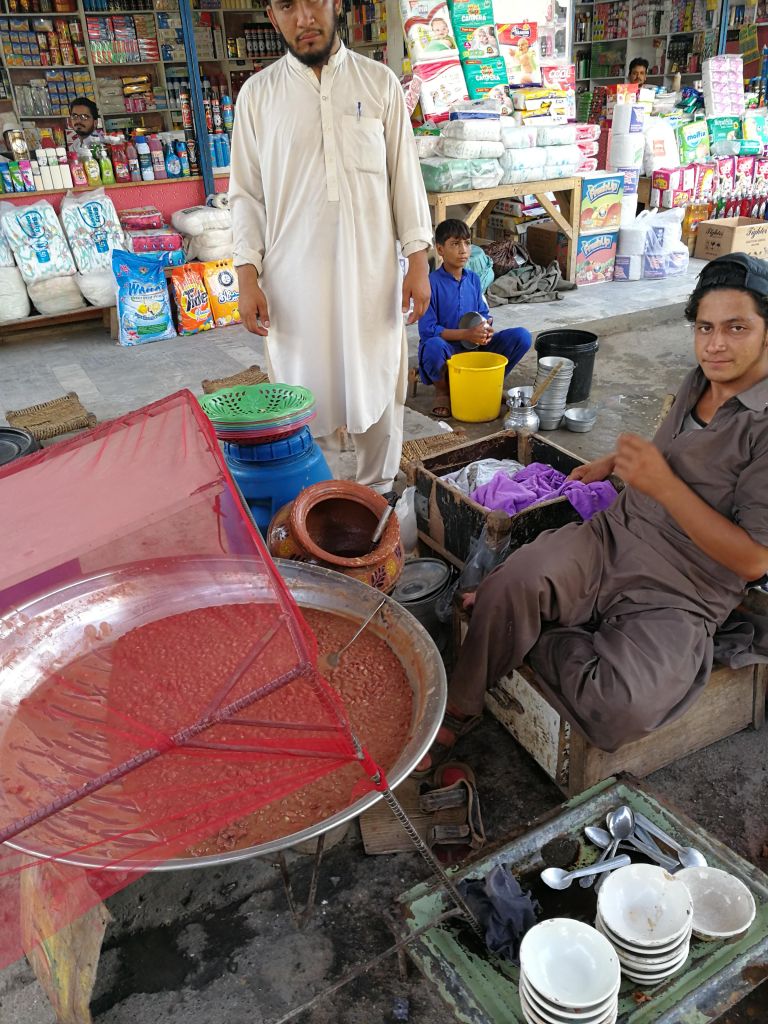
When you stroll along the bazaar walkways you will be served with aromatic smell of local green tea or also known as khava. The green tea leaves are sold by many roadside stalls. When we were discussing how handsome the Pathans looks, Shabbir told us that this green tea is one of their beauty secret. As much as I love to look as handsome as these Pathans, I had reservation buying the green tea leaves. Due to its proximity with Afghanistan, it is also famously known for it’s Afghan cannabis. I don’t have any knowledge of both these leaves. Any wrong moves could cause me to end up on the headline of local newspapers, ‘Malaysian Engineer caught with 1kg of Afghan cannabis’. This headline kept repeating in my mind everytime I saw the green tea leaves.
Coming back to how we arrived here. Shabbir was in argument with the locals as he took their parking spot. He was in a heated argument with them. This is not the first time Shabbir engaged on arguments. Most of the time, even a friendly chat between two Punjabis sounds like ferocious arguments. However, this is an argument between Punjabi and Pathan. Both are known for their animosity.
We quickly approached Shabbir. “What happened yar, why are they shouting at you?”. I asked. “No problem, sir”, there came Shabbir’s standard reply.
The group which was attacking Shabbir turned towards us. I forgot Shabbir’s advice not to show ourselves as foreigners. He told us to lay low and avoid speaking English.
We have calculated the risk; yes, it was low. But the arrangement was as an additional precautionary measure. Due to the tension, I openly spoke in English with Shabbir, revealing our foreign identity. One of the three Pathans looked like a typical Pathan. He had the Afghan hat, salwar kameez with the local chappal. The other two guys have the city look, even with their salwar kameez. “Where are you from, sir?” I turned my attention toward the two city looking guys. I then realized the question came from the Afghan hat typical Pathan looking guy. I was wrong to have this stereotype. “Malaysia” I responded. “Welcome to Peshawar”, he welcomed us with a smile. His two other friends were still blurry. I better put up my famous disclaimer, “I look like a Pakistani, but I’m a Malaysian”. “Yes, yes, you look like Sindhi”. He laughed. I get this label sometime in Punjab. I get upset when they call me Sindhi because they claim Sindhi have darker skin. It is as though telling me you look dark.
But today I need to tolerate this label. We need to get out of this mess. “How long have you been here in Pakistan?” he asked. We usually don’t disclose much information to strangers. “Just for a few days”, I was trying to cut the detail short. “How do you find Pakistan so far?” he sounded curious. This is the most asked question from locals. I have a template response for it.
We continued for a while with the most friendliest short chat. Subsequently, they invited us for a cup of kavha. I couldn’t digest what happened.
We were wrong when we took their parking. Instead of seeking apology, Shabbir decided to engage in argument. However, true to the label, as the friendliest and the most hospitable people, the locals treated us as precious guests.
This was Peshawar, the oldest city in Pakistan and one of the oldest cities in South Asia with the most amiable people in the world.

 Ek Safar (The Journey)